
This blog series is made possible through a partnership with Historic Mobile Preservation Society. The historic photos in this post are used with the permission of HMPS for my “Fragments Observed: Life During Mobile’s Progressive Era” blog series.
For more information about HMPS and their mission, please visit:
https://www.historicmobile.org/
And for their online archives, including requests to use photographs from their collection:
https://historicmobile.catalogaccess.com/home
Fragments Observed:
Life During Mobile’s Progressive Era
Part Five, Sean Spunner’s Homes and Beyond
Is it weird to talk about the homes of fictious people? Possibly, but I’m used to being thought of as a little odd. To me, my people (as I refer to the characters that populate my stories) are as vibrant as anyone I’m sitting in the same room with. I’ve been told by readers that my characters leap off the pages, they’re startling real, and other such compliments. For the halfway point of the blog series I’ll share one way I make my Progressive Era stories come alive for modern readers.
Giving characters real settings to live, work, and play in sets a firm foundation for connections between readers and the stories, especially those familiar with Mobile. When focused on downtown and the historic districts, the layout of the city is much the same with exceptions like neighborhoods that were razed in order for Interstate-10 to be built. (More on that in another post.) Key markers like Bienville Square , Barton Academy, and the cathedral (the latter two are forthcoming) are where they were for over a century and a half.
Sean Spunner of The Possession Chronicles, The Malevolent Trilogy, and Washington Square Secrets (plus plenty of short stories) has had his fair share of time on the page. Readers can see him in several homes throughout his lifetime from his rascally teen years when he lived with his uncle to his era of graying hair. Stories showcasing him span thirty-four years, but for this post I’m focusing on the residences of his adult years.
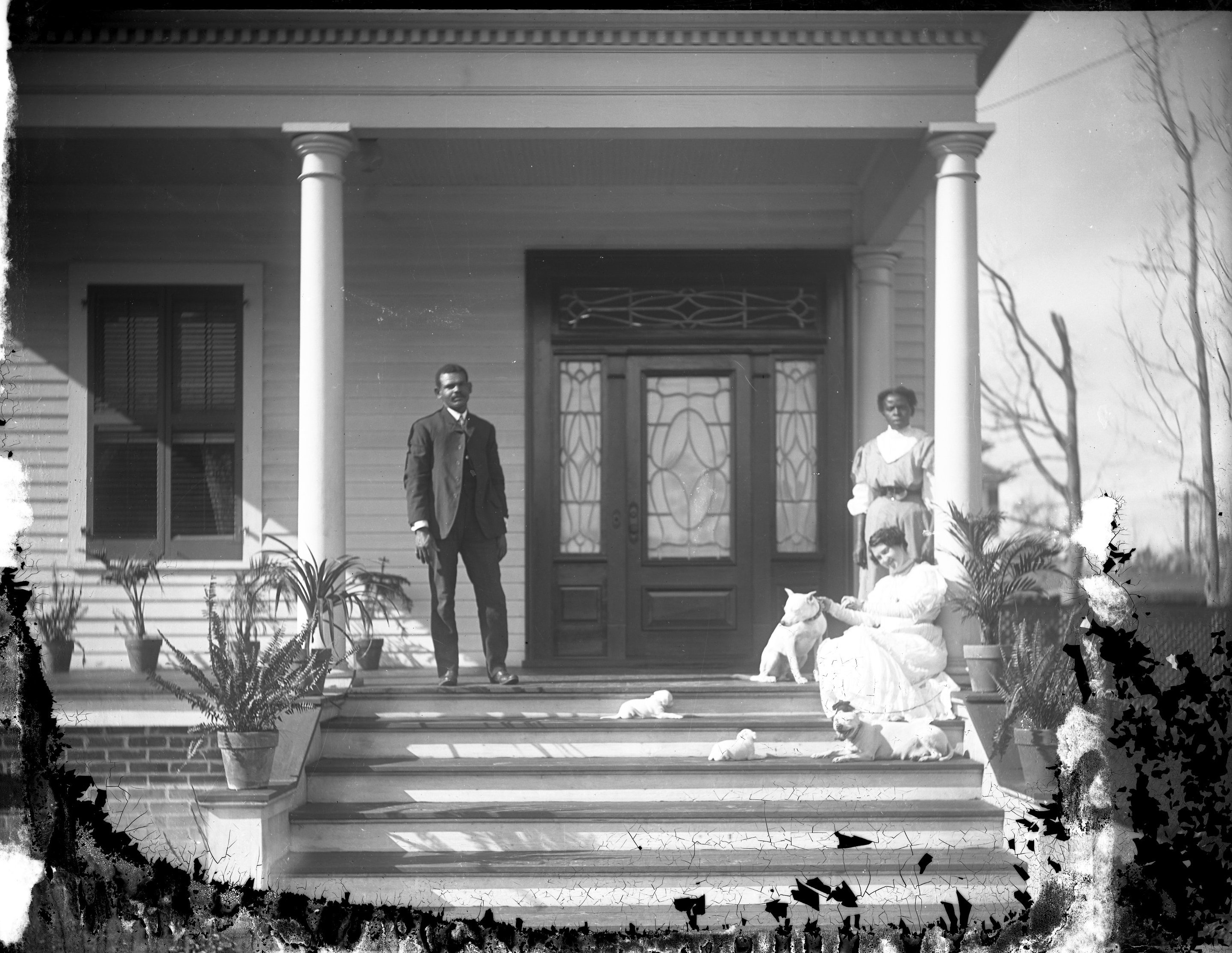
When he moved out of his uncle’s house that was on Palmetto Street between Marine and Broad, Sean set up house on the southwest corner of Rapier and Palmetto in 1905 (as seen in Mosaic of Seduction, The Possession Chronicles #1.5, and Discernment: Washington Square Secrets 1.) Though it was more than half a dozen blocks away, the young lawyer’s home was still in the Washington Square neighborhood which is now referred to as the historic Oakleigh Garden District. Here’s a photo of the house as it looked in about 1905, from the William E. Wilson collection with HMPS.

The real-life lady of the house, a Mrs. S. Wilson, is seated on the front steps alongside her beloved dogs and puppies. The man and woman standing on the porch are listed as being the hired help for the household. Fictional Sean had hired help too. Althea was housekeeper, cook, and mother-figure to him throughout the different tales. Here’s how the residence looks in March 2025.

Looking at the house in the historic photo compared to how it looks today, the change in the porch, doors, and windows suggest to me that the home was most likely made into boarding rooms (many large homes around town were during the 1930s-40s), so that the narrow door that’s now center was added to access the main floor as the stairs are just inside the old front door on the right side of the porch, which could have been used for tenants living upstairs. Then, when the house was converted back to a single-family home, the old main entrance was taken out and that smaller window installed. That’s my theory. What do you think?
Moving forward…
In the opening pages of Tangled Discoveries (The Malevolent Trilogy #2), Sean brings his wife to tour a house that’s for sale at the corner of Houston and Old Government streets in 1916. He hoped to impress her with a luxurious modern home that afforded them more room to expand their family and entertain. Designed by the architect who ruled the Progressive Era in Mobile, Sean Spunner felt the move would help him surpass his peers who were already in mansions designed by George B. Rogers up and down Government Street.

This majestic Rogers design still graces the corner of a now bustling intersection right across from the cannon at “The Loop”—where the streetcar tracks used to loop back to town. (See photo below.) The current owners have lovingly restored the abode to its former glory after decades of neglect. You can see the ongoing transformation on their Facebook page.

As bonuses, here are three more character/family homes from The Possession Chronicles.
The first two buildings date back to the nineteenth century and are situated side-by-side on State Street in what is now called the De Tonti Square historic neighborhood. These homes are on the northern edge of the road between N. Jackson and N. Joachim Streets.


And here they are in photos taken within the past decade, while I was working on The Possession Chronicles.


The third house is a George B. Rogers designed home on Government Street. Originally built for the Burgess family circa 1906, in my stories it houses the Melling family. It’s one of my favorites on the main road.


Which house from this article is your favorite?
Leave a Reply